

Published 25 April 2026
Jeddah’s property market in 2026 sits at a turning point. The new foreign ownership law took effect in January, Jeddah Central is reshaping the downtown waterfront, and the northern corridors keep growing. More buyers than ever are asking the same question: apartment or villa?
It sounds simple. The answer depends on how long you intend to hold, how many people you are housing, and whether you are buying to live or to let. Here is how the two compare in Jeddah right now.
The market in 2026
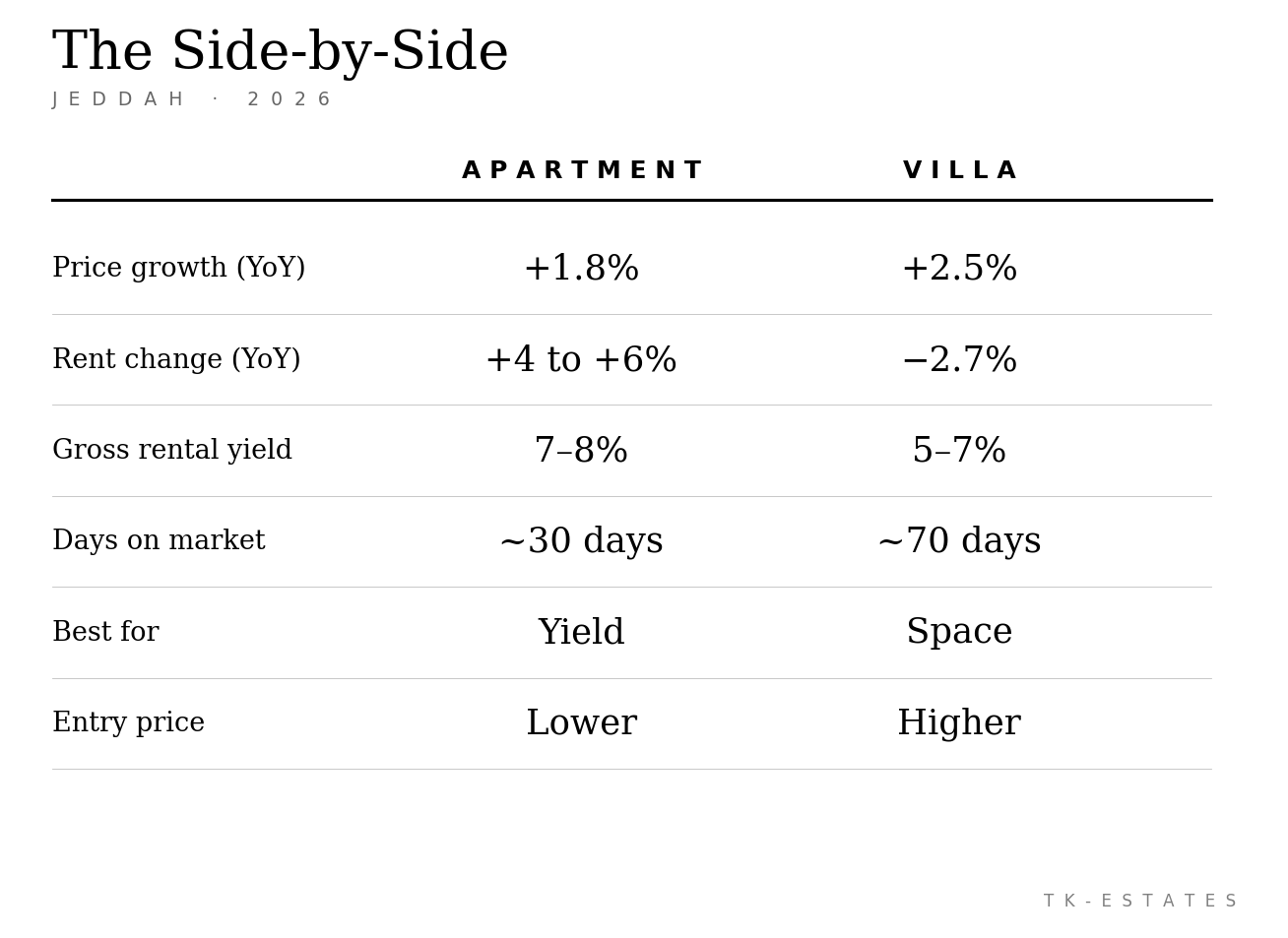
Jeddah is the calmer counterpart to Riyadh. Where Riyadh has seen sharp double-digit jumps, Jeddah apartments rose around 1.8 per cent over the past year and villas around 2.5 per cent — measured growth that leaves room to negotiate.
Apartments now make up the majority of transactions in the city. Villas continue to anchor the family and premium segments. Both have a place.
Apartments: the practical, liquid choice
Apartments have quietly become the defining home of modern Jeddah. They suit professionals, smaller families, and investors who want steady returns without the upkeep of a standalone house.
- Apartment rents are growing 4–6 per cent year on year
- A typical two-bedroom lets at around SAR 3,950 a month, rising above SAR 5,500 in Al-Shati near the Corniche
- Gross yields sit around 7–8 per cent, higher than villas typically deliver
- Vacancy is tightest at 3–6 per cent in prime areas such as Al-Shati and Al-Rawdah
The trade-offs are privacy and outdoor space, and service charges that eat into net return. Floor plans suit the modern Saudi household — now averaging 5.2 people, down from 6.5 two decades ago — but not always a larger extended family.
Strongest districts: Al-Salamah, Al-Rawdah, Al-Zahra, Al-Shati, and the Obhur Al-Shamaliyah corridor.
Villas: space, privacy, permanence
Villas remain the standard for established families and executives who want room and a sense of permanence. They are less liquid than apartments, and they offer something apartments cannot: room to grow.
- Villa prices rose around 2.5 per cent year on year — softer than apartments, but stable
- Villa rents dipped around 2.7 per cent as supply expanded
- Gross yields run 5–7 per cent, offset by stronger long-term capital preservation
- In premium districts such as Al-Zahra, gated three- and four-bedroom units let at SAR 160,000–220,000 a year
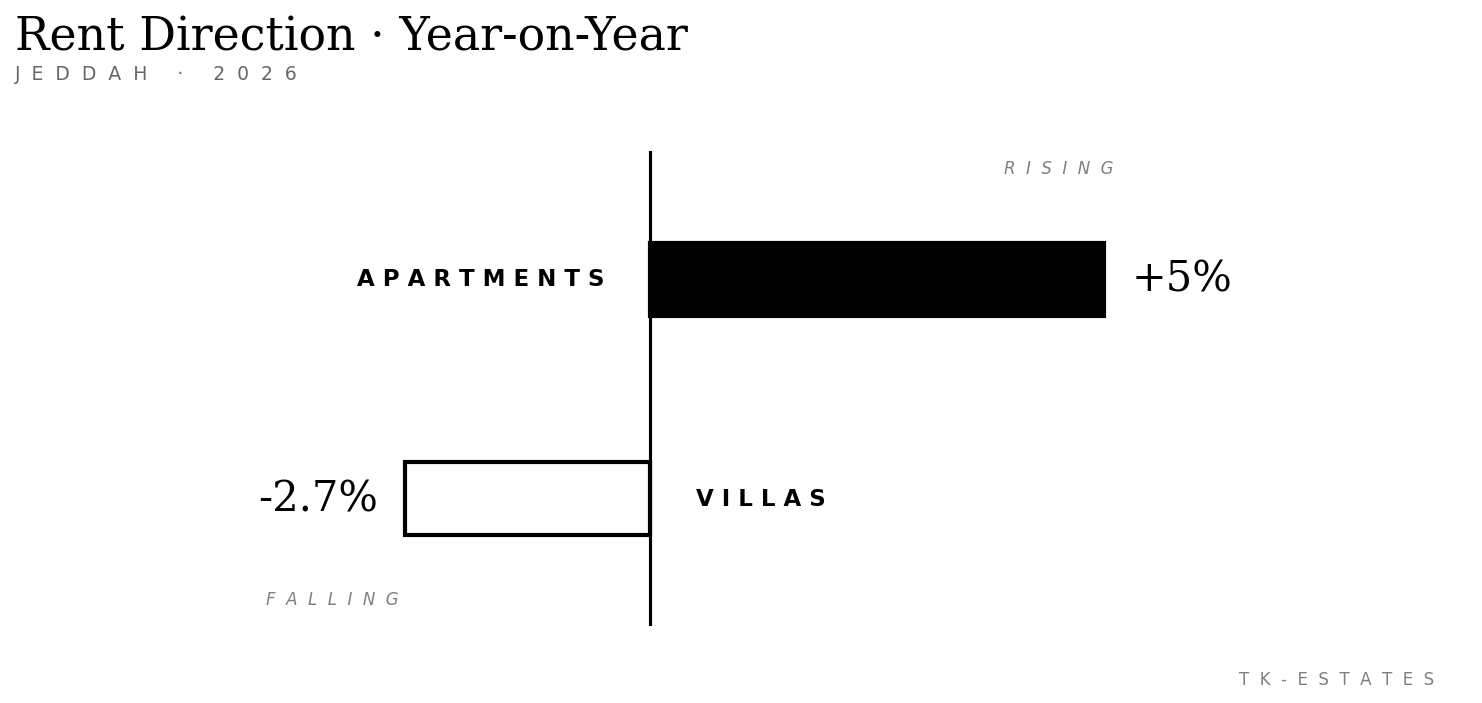
That divergence is worth pausing on. Villa supply has expanded faster than demand. For a long-term villa owner this is not a problem, since capital values are still rising. For anyone weighing rental income, the apartment side of the market is doing the heavier lifting in 2026.
The trade-offs are a higher entry price, higher maintenance, and a slower sale — villas in older inland districts can sit for seventy days or more.
Strongest districts: Al-Zahra, Al-Shati, Al-Mohamadyah, Obhur, and the family compounds of the northern corridor.
Five questions worth answering first
- How long will you hold it? Apartments suit shorter holds and rental income. Villas reward patience.
- How many people are you housing? Above five, a villa usually makes more practical sense.
- To live in, or to let? Investors lean to apartments for yield. Owner-occupiers split more evenly.
- Location or space? A prime coastal apartment puts you near everything. A villa trades that for square metres.
- What upkeep will you accept? Gardens and pools, or a building manager who handles most of it.
What the 2026 reforms change
The foreign ownership law that took effect in January opened designated zones in Jeddah to non-Saudi buyers. That is already pulling fresh demand into apartments in particular, where the entry point is lower and resale easier. Foreign villa demand is concentrated in premium gated communities. Either way, the regulatory environment is the most open Jeddah has seen.
Our view
There is no better choice between the two, only the one that fits your life and your numbers. What matters is the right district at the right price, with full clarity on what you are buying.